Home
  • Home
  • The Group
    • Group Members
    • Collaborators
    • Helping Hands
    • Alumni
  • Research
    • Research Questions
    • Datasets
    • Key Findings
  • Publications
  • News
  • Media
  • Gallery
  • Contact

New paper out by Pettay et al: Female-biased sex ratios in urban centers create a “fertility trap” in post-war Finland

Female-biased sex ratios in urban centers create a “fertility trap” in post-war Finland

Jenni E Pettay, Virpi Lummaa, Robert Lynch & John Loehr (2021): Behavioral Ecology
DOI: 10.1093/beheco/arab007

Abstract

Because sex ratios are a key factor regulating mating success and subsequent fitness both across and within species, there is widespread interest in how population-wide sex ratio imbalances affect marriage markets and the formation of families in human societies. Although most modern cities have more women than men and suffer from low fertility rates, the effects of female-biased sex ratios have garnered less attention than male-biased ratios. Here, we analyze how sex ratios are linked to marriages, reproductive histories, dispersal, and urbanization by taking advantage of a natural experiment in which an entire population was forcibly displaced during World War II to other local Finnish populations of varying sizes and sex ratios. Using a discrete time-event generalized linear mixed-effects model, and including factors that change across time, such as annual sex ratio, we show how sex ratios, reproduction, and migration are connected in a female-dominated environment. Young childless women migrated toward urban centers where work was available to women, and away from male-biased rural areas. In such areas where there were more females, women were less likely to start reproduction. Despite this constraint, women showed little flexibility in mate choice, with no evidence for an increase in partner age difference in female-biased areas. We propose that together these behaviors and conditions combine to generate an “urban fertility trap” which may have important consequences for our understanding of the fertility dynamics of today including the current fertility decline across the developed world.
Read more

Other News

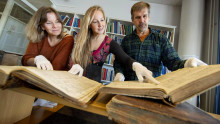
Kirkonkirjojen valtaisa tallennustyö liki valmis

Tarja Repo / STT

Read more

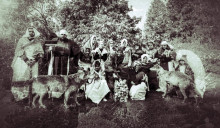
Lummaa Group Grannies had a great meeting in Lammi Biological Station

Special thanks to John Loerh and all the staff at the Lammi Biological Station, University of Helsinki for hosting us!

Read more
Photo by Jonathan Webb, edited by Esko Pettay

Virpi Lummaa interviewed in the Guardian: What is the menopause and when does it strike?

It’s a natural part of the female life cycle – so why don’t we talk more about the menopause, its debilitating effects and possible mitigation?

Read more

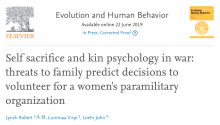
New paper will appear soon in Evolution and Human Behaviour by R. Lynch, V. Lummaa & J. Loehr: see the early version!

Self sacrifice and kin psychology in war: threats to family predict decisions to volunteer for a women's paramilitary organization

Read more

Virpi Lummaa Suomalaisen Tiedeakatemian jäseneksi

Read more

“Grandmother Hypothesis” Gets Some Support - The Scientist 7.2.2019

Read more

New paper out in Nature by Robert Lynch et al.

Karelia-project's newest paper by Robert Lynch, Virpi Lummaa, Kathrik

Read more

Simon's newest paper is published online in Current Biology

ScienceNews 7.2.2019

Read more

Virpi in WEF Annual Meeting 2019 in Davos

Virpi Lummaa is participating in the World Economic Forum Annual meeting in Davos, speaking about her research e.g. in the session ERC IdeaLab: Healthy Ageing.

Read more

Welcome to the multidisciplinary seminar HUMAN EVOLUTION AND CULTURAL CHANGE 1-2.11.2018

Read more
  • ‹ previous
  • 3 of 5
  • next ›

Prof. Virpi Lummaa

Academy Professor
virpi.lummaa (at) utu.fi

Dr. Anne Hemmi

Research Coordinator
hemmi (at) utu.fi

University of Turku
Department of Biology
Natura
Vesilinnantie 5
20014 University of Turku
Finland

Academy of Finland
University of Turku